

Dearest B—
We have truly turned the corner into the dog days of summer. There’s dust and smoke hanging in the air here in near-equal parts, settling on car and home windows in grimy layers, comparable to spring’s pine pollen. It’s too hot and sunny to wash the house windows save for the small patches where I’ve affixed new, reflective stickers to ward off careless avian visitors. The neighborhood car wash will do nicely for the automobile.
If that sounds a bit like spring cleaning, it may be because I’ve been laughing at the complaints in letters between my Dad and some of the lads he went to school with, during the early months of their WWII enlistment. It didn’t take them long to discover the differences in the paths each had chosen or been assigned.
Dad’s must have groused about the inconvenience of having to send all his laundry home from Cornell to his mother to wash. His long-time friend, Vincent Sallese, wrote from his assigned Army Specialized Training Program location, Harvard University.
I don’t know what you make of the course, but to be frank with you, old Mr X (mathematics to you) is doing a good job of befuddling me. As for everything else here, I think it’s swell. But when they make me send home for my own bedding and more clothes & more clothes — well that takes the cake.
Vinnie wasn’t the only person (besides Dad himself) struggling with matters of housekeeping.
Arthur Herbig found himself in the U.S. Navy (see his first, hilarious post card to Dad) instead of the V-12 program at a college. His first proper letter (#031, March 22, 1944), sent from the U.S. Naval Station at Sampson, New York, begins by commiserating with his friend about math:
Keys to that Math. You will get along alright. Just concentrate on the “why” and “how” of it. You will get a much better idea of a proposition or formula if you study the reasons why the formula was originated.
But he soon pivots to some pointed observations about the Navy’s passion for spick-and-span.
As you said, the experience is very interesting and memorable. My second day here, I was given the extreme honor of guarding the Head†. Maybe they were afraid that someone would try to steal it. … Life here is vigorous and clean. The U.S. Navy is, perhaps, the cleanest in the world. You should see your face reflected from the wooden floor of our barracks. We use a lot of elbow-grease here.
Artie had gone into the Navy with high hopes for his wartime career.
I will graduate (I hope) about the 14th or 15th of April and then we get a seven day leave. I am trying for a branch of the Naval Air Force. If I am not qualified for flying — Aviation Machinist’s Mate is next.
† PS. Men’s Room.
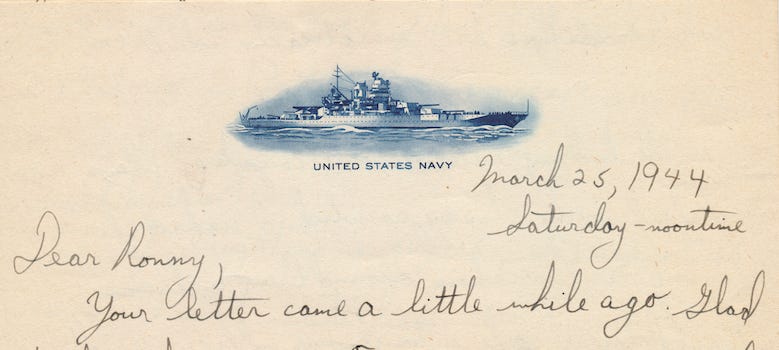
Able Seaman Herbig’s next letter (#039, March 25) is less upbeat. He acknowledges Ronie’s grumbles about the tough transition to military discipline and exacting standards — “we are leading practically the same type of lives” — but Artie is lumbered with chores instead of books:
… we have no studies. Instead, we have additional “chores” to do such as washing clothes and hanging them on the line a “prescribed manner”, cleaning the whole barracks every morning so that —
a) The Commander can see the reflection of his face on the center aisle floor. (Horrors!)
b) Not one molecule of dirt or grease seen on the thirty some-odd portholes (windows to landlubbers)
c) Even if everything is perfect, the inspector is still not satisfied.
Because Artie was already in formal service and not detouring through a college course as Dad and Vinnie were doing, he found himself confronting the realities of his assigned role sooner than they did.
I had my interview a couple of days ago and feel very disappointed. I asked for flying or Aviation Ground Crew and was turned down. The interviewing officer said the quota was filled on all aviation branches. The only things open were — Hospital Corps, Radioman, Radio Technician, Electrician’s Mate, Torpedoeman’s Mate. Out of five of the lousiest choices I had to choose from my decision was —
1st choice — Torpedoeman’s Mate
2nd choice — Electrician’s Mate
Luck must have been looking the other way that day. I don’t know the first darned thing about a torpedo. They are to send me to a school for 4 mos. after my leave is up.
Making progress, avoiding the Infantry (if possible)
My father had formed his own opinions about the pros and cons of the detour through three months of college that he and Vinnie had agreed to through the ASTP (sometimes referred to with an ‘R’ meaning Reserves). In a long letter home on April 26 (#081), he asks Ron Senior to pass a message to his cousin, Warren, who was about six months younger and not due to enter service until after graduating from high school in June.
Pass on some good news to Warren in regard to ASTRP. The program is being improved and enlarged with better breaks than those which I will get. If he stays in for 3 terms and studies hard and is in the top 10%, he may be sent to engineering school. The course which now promises nothing (except the gov’t support of colleges) will be closer linked to the Army both in curriculum and drill. (Now we study for no goal, while academic work blocks out drill and Army routine and visa-versa; giving those who try to do the job right a pain in the neck.)
Dad also has critical remarks for some of his Cornell ASTP cohort:
There are a great number of fine fellows here, with good qualities. Most of us will be shipped out in May for fighting units (we hope). There is however that small percentage of rats, sissy-babies, jerks, etc. You can pick them out by their uncooperative spirit, cowardliness (some have asked how to get into a desk job or out of the Army), slovenliness (which showed up at dress inspection today), and their general unpopularity with the rest of the men. It is unfortunate that the Army does not have higher standards for A-12. We have quite a few misfits both mentally & spiritually.
The Navy has higher standards and gives the men a goal. The Army shows us the infantry or what [the] war happens to be needing as the goal. As I said, this isn’t what I expected or wanted.
Math, which was as my Dad pointed out to his cousin, essential to entering an engineering program, continued to bedevil him, despite his friendly approach to trigonometry. While his other marks were better (a 90 in history, 85 in geography), it’s unsurprising he considered other paths outside the tech sergeant stripes that seemed ever more elusive.
All is not lost tho, because those who do well in military work (drill etc.) stand a chance for instructors ratings as specialists. What job shall I try for when they ask me “What can you do, or want to do?” I am undecided for I don’t know what civilian job I’m steering for or what I am best suited for. (I imagine the Army will have the say on that anyway.)
The notion of entering a technical specialty, with its higher pay and respect, greatly tempted young, fed-up, Private Ronie. On May 1, (Letter #091), he wrote to his father:
I had an interesting chat with one of the O.D.s* (Lt. Junger). We would have had a driving session in the truck except for the fact he was busy. Oh well, I’ll learn all that in basic plus a great deal more. I rather anticipate going to basic. I understand they need instructors in motorized and ordnance divisions. That would be a break — Sgts stripes and specialists pay. Of course this is just wishful thinking but it ain’t impossible.
(* For once, O.D. doesn’t refer to “olive drab” uniforms, but to the Officer of the Day. Small wonder I was perpetually confused by some of these letters…)
If nothing else, being an instructor meant never being the lowly private assigned to vehicle-cleaning detail.
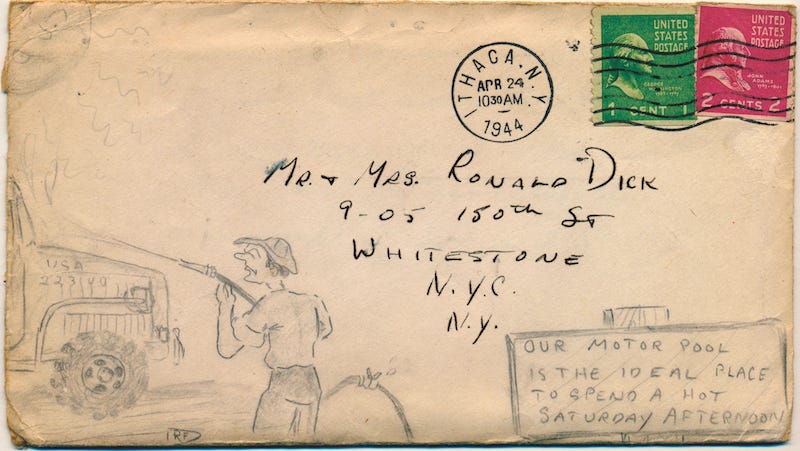
On May 10 (Letter #105), with less than a month left in the term, he reported:
All subjects at par with slight rise in English. Chemistry climbing but at expense of Math and Physics. The process is one of “robbing Peter to pay Paul.” To learn all at once verges on the impossible if one has no math’ background; But we struggle on… If you flunk — Infantry … if you pass — Infantry! I can hardly wait for basic! Camp Dix, here I come. My military science marks are among the 10 highest… (oh that my math’ were the same.)
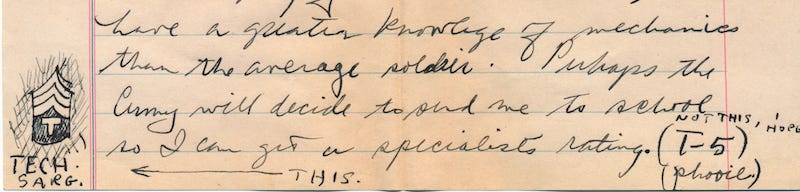
If I have the opportunity to apply for anything it will be for motorized or ordinance. I have found, to my surprize, that because I have been helping you with the car, I have a greater knowledge of mechanics than the average soldier. Perhaps the Army will decide to send me to school so I can get this specialists rating. Not this I hope (T-5) (phooie)
← THIS.
Fatherly words of advice
Ron Senior meets these mid-term musings by sending admonitions laced with encouragement. One of his favorite phrases was “keep punching!” Another was to “bear down for a Garrison finish.” He used the phrase four or five times over Dad’s time at Cornell, for instance in April (#088):
Well, the rain still continues down here … hampering the planting of our victory garden. I hope you are preparing for a Garrison finish on the Chem., math, science or physics so that you can put the marks well up near the top. I know you can do it if you dig in.
And again in May (#103):
According to the cheerful note in your letter I would say that the marks are climbing … Once you really get on the ball and punching, the Garrison finish on your first semester will be a sure thing.
My father had already written home describing all the uniform and kit the young men had been issued, and a “garrison cap” was on the list:
Today we got our summer uniforms, regulation G.I. We will start wearing them on the 10th. We were issued:
1. 4 prs pants, size 28 W, 32L
2. 4 shirts, size 14 - 2
3. 1 garrison cap, 7 1/8
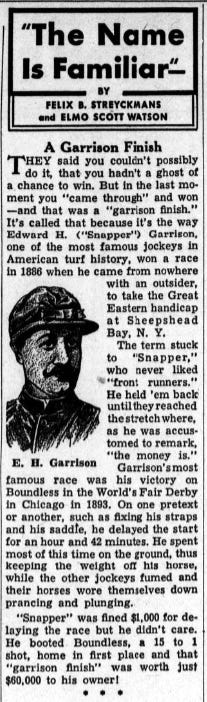
But how would a soft, crushable hat help one in schoolwork? It was pure luck that I stumbled upon a Wilkinson County, Georgia, newspaper column featuring bygone slang. Thus I learned that the phrase had nothing to do with an army garrison. It refers to Edward “Snapper” Garrison, one of the top three American jockeys in the beginning of the sport of horse racing in the 1880s-1890s. The ‘Garrison finish’ was named for his practice of holding his mounts back till the ‘money moment,’ then thundering in to win in the last stride or two.
Aside from invoking long-gone jockeys, Ron Senior often shared some tidbit of scholarly or military history that he thinks will encourage or inspire his son. For instance, in early April (Letter #069), he responded to his son’s description of “Mickey Mouse” movies, writing:
I do not consider your letters shocking in any way. As Klauswitz [Clausewitz] “On War” says, “the main requisite of soldiers is courage and this born of faith in himself, his leaders and the cause.” Every man is born with it since it is a heritage dating back to the beginning of time.
As the Bible says, God created man after His own image. Realizing this truth we know that courage is a heritage directly from Him and that all possess it. The only thing is that at some times we “man” allow our imagination to build up a false idea, call it fear if you will, but still it is false and does not exist.
I read of an incident in this war where a young man asked for permission to accompany an older and more experienced man on a dangerous mission. It was granted tentatively. While crawling through the brush they were attacked by an enemy patrol. At this time accuracy in marksmanship and teamwork counted, they must depend on each other. The veteran then said, “before we betray our location to the enemy I want to know if you are scared.” The younger man answered “scared stiff.” The older man then said “Let’s go then, I know I can depend on you because you will also be depending on me.” and so they successfully overpowered the enemy.
Fear, the false idea, is like that. When the pinch comes it disappears, and often-times is a great help because it stops you from going off half-cocked.
A few weeks later (#090), he writes in lighter vein:
I wrote you in one of my letters a short time ago about Alexander the Great being a great military genius. Now you have sent me an idea of the type of trigonometry you are learning at Cornell. The connection I am thinking about is this.
One of the most trusted generals of Alex’ wrote the first treatise on trig. His name was Ptolemy and after Alexander’s death he received Egypt as his share at the division of the spoils. You might get a little help if in your spare time on a rainy day and must stay indoors to read a little on Ptolemy and also the inventor of trig., Hipparchus. The reading will be interesting not only from the math point of view but also from the historical end.
Rainy day reading, indeed! Should it decide to rain here (and not an August thunder-and-lightning storm, TYVM), all of us tending our modern-day victory gardens will be very grateful.
Your loving friend,
Laura