

#31. Anticipation.
The Spring 1944 semester at Cornell draws to a close, bringing real soldiering closer
Dear N—
You made me laugh with your funny description of coaxing the ketchup out of the bottle at your Indie Day cookout while dancing around singing that old Carly Simon song. Did the teenagers at your party have the slightest idea what you going on about? (I’d have resorted to a butter knife in the neck of the bottle much sooner.)
My Dad once drew a full-page cartoon of himself captioned only, “Anticipation.” It shows him in full olive-drab uniform, mounting guard with his rifle outside the barbed-wire enclosure of the Cornell R.O.T.C. The sky above him has clouded over with an “impending storm;” a solitary raindrop is falling straight into his outstretched palm. Even the moon above looks fierce and alert. The soldier’s face suggests resolve and fearlessness, the determination to do his job, but that caption… Surely there’s a touch of dread as he anticipates but cannot know what he would be called upon to do, how that resolve might be tested.
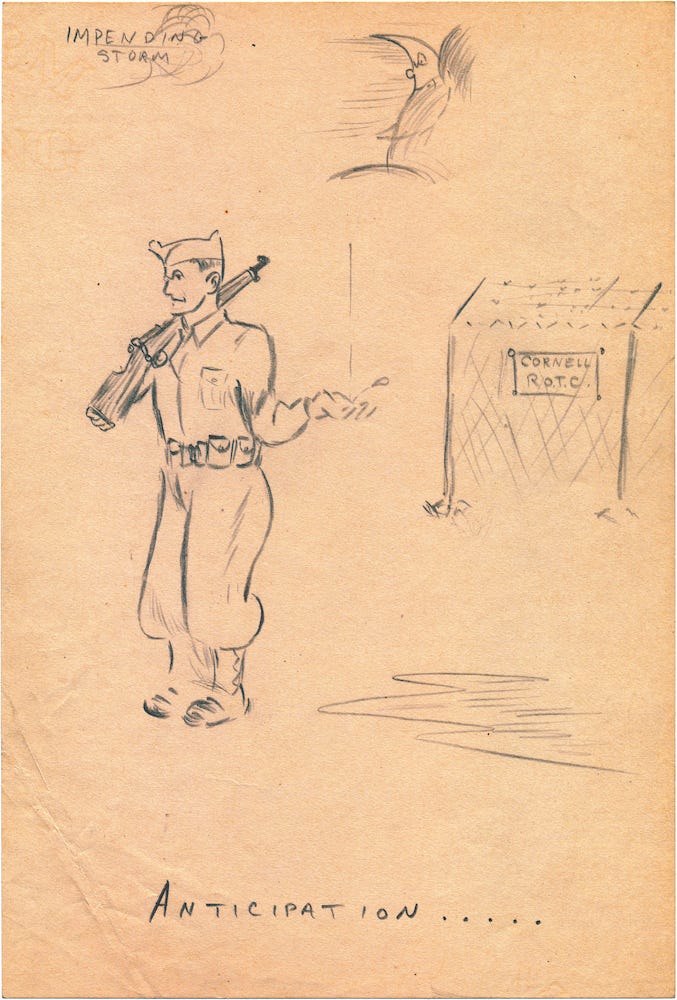
The letter (#086) accompanying it ran a couple of pages but did not dwell on the future. The ink was mostly spilled in giving his two sisters copious big-brotherly advice:
Helen’s letter asks for some advice so here goes. In the first place I want to advise you to keep away from the “easy” subjects. If you want to take science, go at it whole hog or none. Take regular chem, not applied; take regents physics, not war physics. If you want to take science, take it with the idea of doing your best and getting the highest marks, not just passing.
I was also a New York schoolchild, so I knew “regents” referred to the New York State Board of Regents, which awarded scholarships to students passing set exams in advanced courses with excellent grades. I wondered, though, about “war physics.” Even before 1941, high school chemistry and physics classes tended to emphasize practical applications for the knowledge gained in the laboratory: How chemicals might be used to improve soil quality or sanitation, how the basic principles of physics helped identify the qualities of sound or electronic waves. War accented the need for such applied scientific studies. Esoteric or ‘pure’ sciences were out of favor, but some high schools, apparently including Bayside, continued to offer such courses.
A hint as to studying: if, in your spare time everything you read is related to your work in school, you will find yourself with knowledge you didn’t have to study to get. Comic books dull your mind to factual thinking so read the encyclopedias or good magazines and books. Perhaps this is a corny idea to you but if you really take your work seriously the sacrifice of comic books will not seem great. You’re quite a young lady, Helen, and intelligence as well as beauty and good manners is quite the thing to strive for.
Helen is 15 years old; I should point out, her letters rarely seem to quote comic strips nor even name them… Judging by the many phrases in his letters that carry a whiff of Little Orphan Annie or Li’l Abner, Ronie had at least a passing acquaintance with them. (“A-hem,” as Helen might say.)
Ronie’s littler sister, Edie, also came in for her share of advice:
To Edythe: I’m glad to hear that you have been practicing and that you know your music. I also like to hear about good marks, but how about math? (I ask that question all the time now! (I don’t do very well in it either.).) I hope you will take care of my stamp album and the stamps I send down there to you.
At the time, my Dad was fighting with logarithms, sending home to his family woebegone accounts (Letter #102) of his efforts to master trigonometry.
Today we covered in less than an hour over a week’s work on Fundamental Identities, a subject covered in over a week in High School. Naively, I asked the teacher how the H: he expected me to learn 8 formulas and how to derive them with only one hour’s teaching. He enlightened me in the following manner:
“1. We realize that the time is extremely limited for the amt [amount] of material covered. 2. Therefore, we throw it at you, hoping that something sticks. 3. For those that have had Trig., the course is relatively easy but for those without any math, it is extremely difficult.” To which he added that he realized that I was trying and that I was ‘catching’ a great deal and that he counted effort as a great part of his marks.
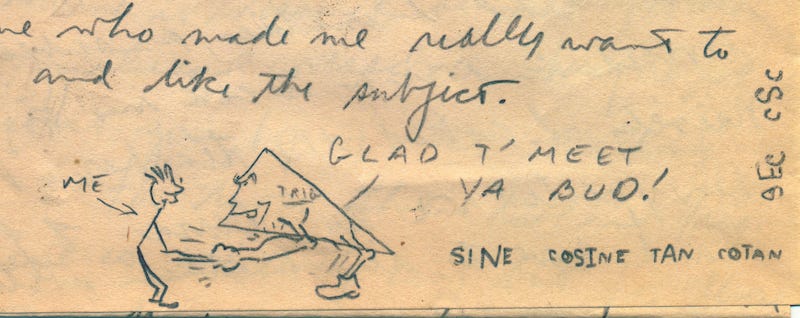
Mr. Piser is the type of math teacher I like. If I am ever fortunate enough to have him as math teacher in peacetime I am sure I would be proficient in math. As it is, he is the one who made me really want to learn and like the subject.
And here, my Dad inserted a cheery little cartoon of himself making the acquaintance of a trigonometry figure.
The old high school gang scatters past their ASTP college campuses after induction
Soon enough, my Dad would find himself with little time for anything but scribbled notes, abandoning multipage letters to rely on the post card. This was true of most of his high school friends, too: the shoeboxes contained a flurry of post cards each time their circumstances changed.
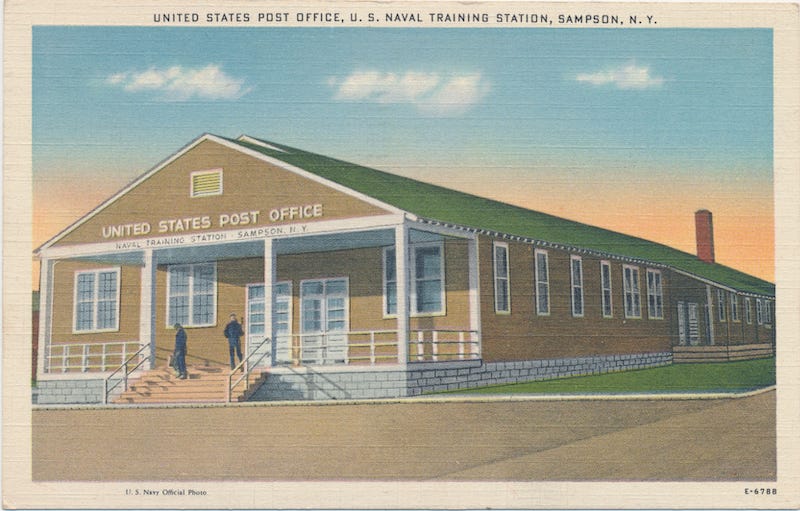
Artie Herbig, for instance, was a great sender of post cards. [As you may see in my letter #28.] Among the first (#076) was an illustration of, of all things, the United States Post Office on the Naval Training Station in Sampson, New York.
A month later, Artie had been reposted to the 16th Battalion stationed at the U.S. Navy base in Newport, Rhode Island. This card (#092) was a handsome watercolor of the harbor area, a black sedan with sweeping fenders contrasting strangely with the three-masted sailing ship moored at the wharf.
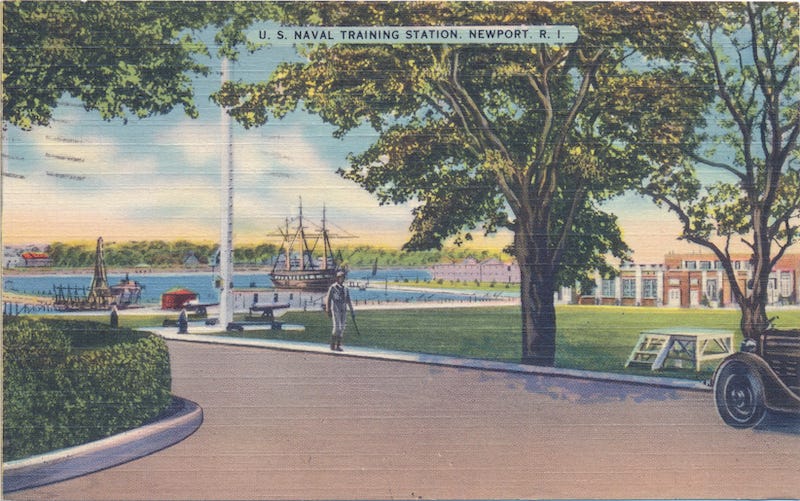
Although he occasionally found himself assigned to “guard the head* (*toilet),” Artie discovered the Navy was not about to waste anyone’s time with such unimportant matters as trig’ problems. He was swiftly enrolled in an Electrician’s Mate course at Sampson, but already anticipated — that slightly apprehensive word again — being transferred to a new base “shortly.” His follow-up letter (#094), sent the next day, clarifies the situation:
Dear Ronnie, I just received your card and look where I am. I was shipped out of Sampson last Wednesday and wasn’t there long enough to rate a liberty to see you. From the looks of things, I won’t be staying long here either. Will probably be gone before the 10th. Write soon to catch me before the zero hour. I’m to take an Electrician’s Mate course of 16 weeks at the new base. I don’t know where I’m going.
Artie closes this brisk, businesslike note with a touch of anticipatory homesickness. He tells Ronie what he knows about their old buddies, already dispersed far beyond the Queens city limits:
On my leave (April 13-20) I saw [Arthur] Meyer and [Vincent] DeNicola. They left on Saturday (April 15) — Meyer for the Air Corps and DeNicola for the Army. I haven’t heard from them since.
He then closes with a wistful description of the train route leaving New York for Newport:
The train to [Newport] passed thru Long Island City and Astoria on the way up. I could see LaGuardia Airport and the Whitestone Bridge. So near — and yet so far.
Some lads were still safe at home, waiting
One or two of my father’s high school pals — including his cousin, Warren — were six months or more younger, and had missed the autumn A-12 and V-12 exams that might qualify them for the advanced Army or Navy training. They were still in high school, preparing themselves to face the draft board if they missed the spring 1944 exams. One such person was the lively neighborhood correspondent, Dan (or Danny) Donohoe.
Danny appeared early in the correspondence — or at least, his mother did, along with the mother of their classmate, Mrs. Bobenko — as a group of ladies wishing my father well in a March 18, 1944, letter from Edie (#025). Danny’s sister even makes an appearance (#033, from Ronald Senior):
Mother is very happy since she is doing war work at Wheeler’s. She has met quite a few people we know, including Mr. Light who lives next door to Grandma Dick’s, also Danny Donahue’s sister and many others. Not only is the social end pleasant but work is light, the pay good and the hours not too long.
Edie bumps into Danny himself a few weeks later, and reports “he went in for a physical this Saturday but he hopes he isn’t taken until he graduates this June.” He promised Edie he would write to her brother soon, and makes good on it the very next day, April 3 (#054). And my, my, but did he have news once he finally got going! I can’t resist giving you snippets from the whole thing.
About two weekends ago after I received your card I spent the weekend in Philadelphia. My sister’s cousin got married and so it was quite an affair. After I left the reception on Friday I stayed at my aunt’s until Sunday night. It seems as soon as she put me on the train, I discovered later, she met with an accident. There was an explosion in the ladies room and somehow a mixture of gas resulted. Luckily my aunt’s screams were heard among others, so they were promptly rescued. She fainted and was rushed to the hospital, however she is alright now and she will probably get a new fur coat because the one she wore was insured.
About two weeks ago, Arthur Meyer moved to the Beechhurst Towers. They have an apartment now which in my opinion is not too satisfactory, however it is a wise move because when he leaves she [his mother] will be alone and naturally she could not take care of a house.
I learned that the reason Danny might have considered the Towers a bit ‘unsatisfactory’ was its lingering (ahem) reputation. It seems that during the silent film era, Beechhurst was a favorite vacation area for the rich and famous. Estates — some built by my father’s Grandpa Dick in his master builder days — lined the waterfront. The Beechhurst Towers hotel was a favorite of actress Mary Pickford, frequented by many Broadway and early movie stars, including the Marx Brothers and W.C. Fields. By the 1940s, however, the hotel was home to modestly paid showgirls until it was converted to apartments — likely right before the Meyers took up residence.
Lately we have both gone roller skating at the Queens Roller Rinks on Sunday nights which has been much fun. I don’t know if I told you but we are also taking dancing lessons at Arthur Murrays, which is a good way to waste money. However we split the lessons so that it would only cost ten dollars a piece which was very wise.
With a bit of money in their pockets from after-school jobs, it seems the lads back home made the most of their evenings and weekends. They wouldn’t have to go into Manhattan to find their fun, either. In 1941, a large, dual-purpose ice- and roller-skating rink had been carved out of the New York City exhibition hall left over from the 1939 World’s Fair. A bit closer to Whitestone was the Queens Roller Rink, off Woodhaven Blvd., which described itself as a popular destination for young people, semipros and pros alike. In the Long Island Daily Press for Sunday, December 20, 1943, it advertised: “Every Sat and Sun afternoon 2-5pm, every evening 8-11:15. Elementary dance class tonight 7 to 8.” Dancing on roller-skates? Shades of Fred Astaire and Ginger Rogers in Shall We Dance!
Ballroom dancing seems just as unlikely for a pair of 17-year-olds, but their choice of training was top-notch: in 1946, there were 72 franchised Murray studios, grossing nearly $20 million a year. The school was even name-checked in the popular song “Arthur Murray Taught Me Dancing in a Hurry,” a Johnny Mercer tune featured in the 1942 film, The Fleet’s In, sung by Betty Hutton.
Besides skating, dancing and going to the even boring movies, I am also attending lessons in Red Cross with my good comrade Bobenko. Every Thursday night from eight to ten we absorb every point that is brought out. The reason we go is because it is required for graduation among other things, as you have experienced… I suppose that is all the news you would be interested in, besides it is now twelve p.m. and I have a full period Eco’ [economics] test tomorrow.
I assume Dan means lessons in first aid. The American Red Cross (ARC) trained thousands of civilians in such vital areas as first aid, water safety and nutrition. Ads and news clips regularly promoted training classes to residents of Queens and the other four boroughs, while students earned school credits for completing the certificate. After all, Eastern Seaboard civic leaders still worried they might be shelled by enemy subs and aircraft. Even teenagers more interested perfecting their Lindy Hop than bandage techniques could bolster their communities’ nursing capabilities.
The next time I write, I’ll have to tell you Danny’s yarn about how “good comrade Bobenko” put those first aid skills into action. Does that promise bring on a little anticipation??
Your loving friend,
Laura